

Ceramics history begins not with a vessel but with a woman. The Venus of Dolní Věstonice, a 29,000-year-old fired clay figurine from the Gravettian period, is widely considered the world’s earliest ceramic artifact. Small enough to fit in the palm of a hand, glazed black through accidental firing in a hearth, and bearing a child’s fingerprint on her surface, she embodies the earliest intersection of touch, craft, and transformation.
As a contemporary mixed-media artist working at the intersection of texture, natural materials, and ancestral craft, I felt an immediate pull toward her. My practice at TextureScape Studio is rooted in exploring how earth materials remember—how bark, clay, stone, and carved surfaces carry stories across time. Encountering the Venus felt like finding the origin point of everything I search for in texture.
One night in my studio, after studying her silhouette and surface, I created a watercolor interpretation using earth-toned washes. This 2025 painting became a turning point. The figurine’s intentional curves and imperfect finish resonated deeply with the way I build textured canvases—layer by layer, as if uncovering something prehistoric beneath.

Artisan Treasures Through Time
The Venus now launches my new series, Artisan Treasures Through Time, an artistic inquiry into ancestral ceramic forms. Each installment will pair an ancient artifact with a contemporary mixed-media response, exploring what early makers understood instinctively: that shaping earth is a way of shaping identity.
The Dolní Věstonice site, a Paleolithic workshop of ceramic experimentation, also informs this project. Over 2,000 fragments—including animal figurines and early kiln structures—reveal a community that embraced clay not for utility but for expression. This lineage of artmaking outside function is the thread I aim to continue.
A century after her discovery, the Venus is now headed into space aboard ESA’s EnVision probe—a symbolic act that connects prehistoric fire to future worlds. Through my series, I hope to continue her journey in another direction: bringing ancient textures and stories into contemporary art practice, honoring the first fingerprint by adding my own.
The Venus of Dolní Věstonice: The World’s First Fired Artifact
-
Discovered: July 13, 1925
-
Location: Dolní Věstonice, Moravian basin, Czech Republic
-
Age: 31,000–27,000 years old (Gravettian period)
-
Material: Local loess clay + ground bone
-
Firing: 500–800°C in a hearth (accidental self-glazing black finish)
-
Size: 11.1 cm tall
-
Unique Detail: A child’s fingerprint (age 7–15) on the surface
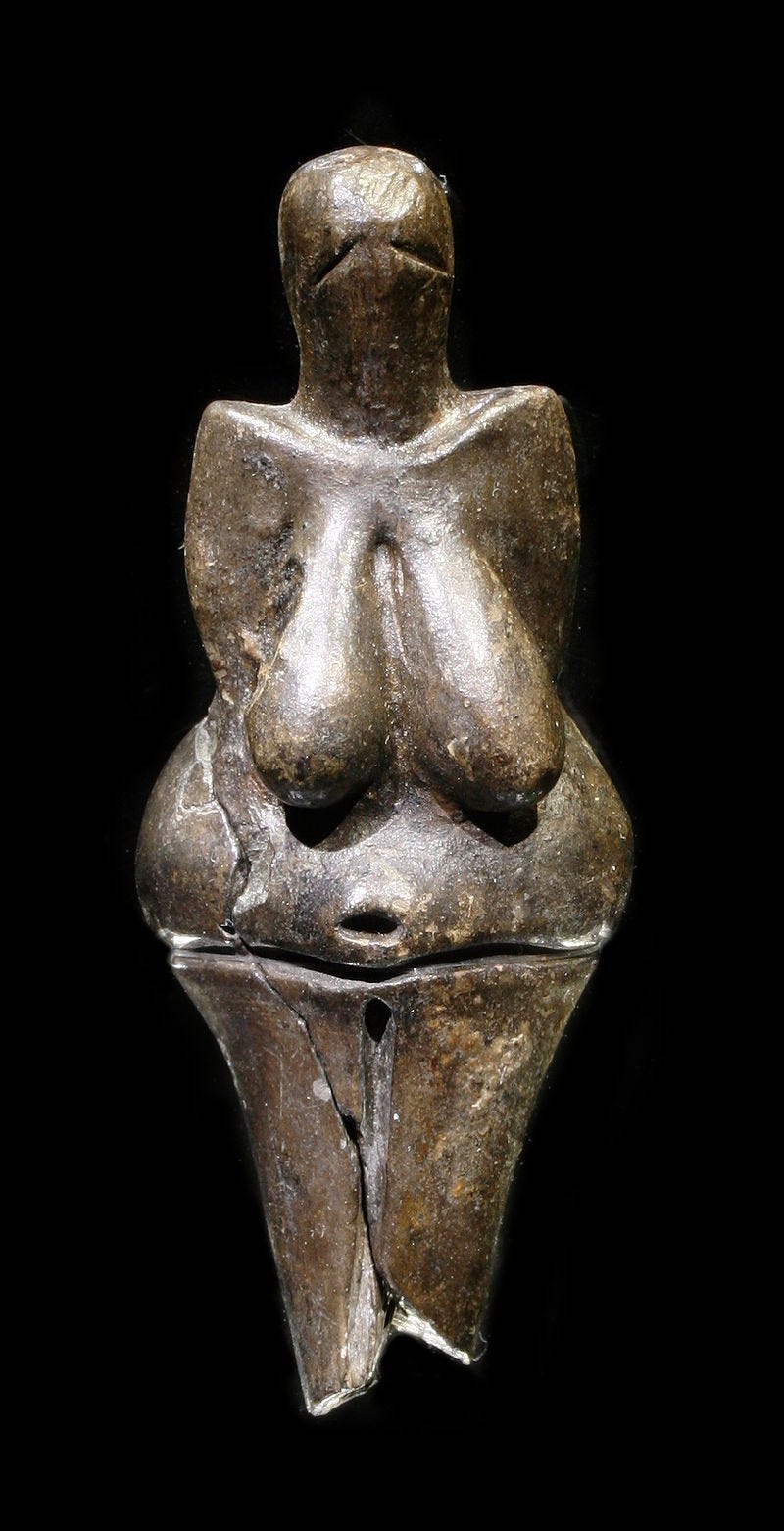
Found broken in two pieces inside a central fireplace, she lay among more than 2,000 clay fragments—animal figurines, textile impressions, early kiln structures. This was not random. It was a workshop, a community of makers experimenting with fire at the edge of the Ice Age.
Five Theories About Who She Was
-
Fertility symbol – a prayer for life in a frozen world
-
Survival ideal – curves as hope against famine
-
Self-portrait – created by a woman from her own viewpoint
-
Child’s doll – the fingerprint hints at teaching, play, legacy
-
Ritual object – broken in fire to release her spirit
No single answer fits. Like all great art, she holds multitudes—just as I hope my own work does.
A Centennial Journey: From Moravia to Outer Space
In 2025, exactly 100 years after her discovery, a silhouette of the Venus will fly aboard the European Space Agency’s EnVision probe, etched onto an instrument bound for the planet Venus.
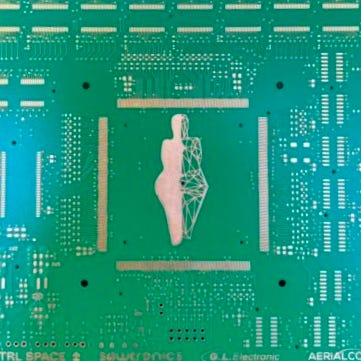
From a Paleolithic hearth to the cosmos—she travels 29,000 years and 261 million kilometers, carrying humanity’s first creative spark into the future.
The Series Begins
Each chapter of this new journey will:
-
Unearth an ancient artisan treasure
-
Pair it with my contemporary artistic response
-
Explore what these early makers can teach us about craft, survival, and the human spirit

